




How to Calculate the Right Ventilated FIBC Capacity for Your Product
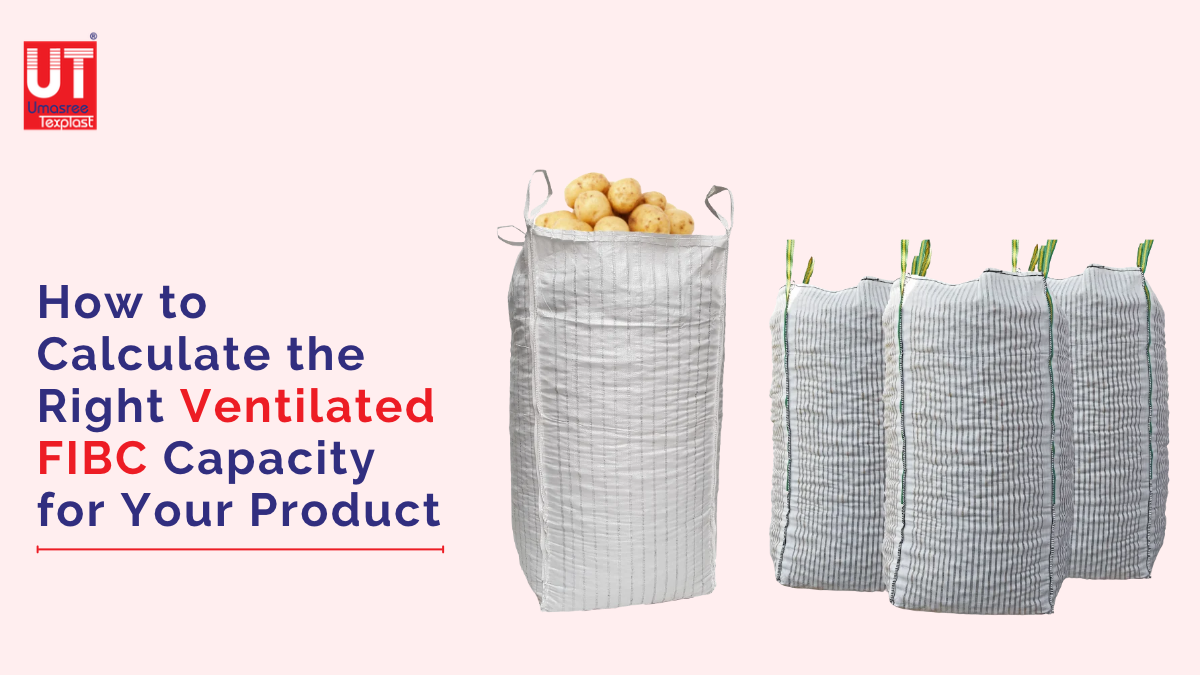
Choosing the right Ventilated FIBC Bag is about more than deciding how many kilograms of product you want to pack. The bag must provide enough volume for the product, support its weight safely, allow proper airflow, and fit smoothly into your filling, storage, and transportation process.
This is particularly important for products such as potatoes, onions, firewood, logs, fruits, vegetables, and other materials that benefit from continuous air circulation. A bag that is too small may be difficult to fill correctly, while an oversized bag can waste storage and transportation space.
So, how do you determine the right capacity?
The process starts with understanding your product rather than simply choosing a standard bag size.
Why Ventilated FIBC Capacity Matters
Ventilated FIBC bags are designed with breathable sections that allow air to circulate through the packed product. This circulation can help reduce trapped moisture and heat, making these bags suitable for products that require ventilation during handling, storage, and transportation.
However, ventilation alone is not enough.
The bag must also have the correct capacity for the amount and type of product being packed. Two products weighing exactly 1,000 kg may require completely different bag sizes because their bulk densities can be very different.
For example, a dense agricultural or industrial material occupies less space than a lightweight product at the same weight. This is why choosing a Ventilated FIBC Bag based only on kilograms can lead to incorrect sizing.
Start With the Target Product Weight
First, decide how much product you want each bag to carry.
Your target could be 500 kg, 750 kg, 1,000 kg, or another quantity depending on your packaging operation.
Consider how the bag will move through the complete supply chain. Think about filling equipment, forklift handling, warehouse storage, pallets, truck or container dimensions, and unloading at the destination.
The ideal load should support efficient handling without creating unnecessary difficulty at any stage.
Once the required product weight is clear, the next important factor is bulk density.
Understand the Bulk Density of Your Product
Bulk density tells you how much a particular volume of material weighs. It is commonly expressed in kilograms per cubic metre.
It has a direct impact on the required FIBC capacity.
The basic calculation is:
Required Volume = Product Weight ÷ Bulk Density
Suppose you need to pack 600 kg of a product with a bulk density of 400 kg per cubic metre.
The required theoretical volume would be:
600 ÷ 400 = 1.5 cubic metres
This means your product requires approximately 1.5 cubic metres of volume before factors such as filling behaviour, headspace, bag construction, and product settlement are considered.
This calculation gives you an excellent starting point for selecting the appropriate Ventilated FIBC Bag.
Do Not Confuse Weight Capacity With Volume
This is one of the most common mistakes when selecting FIBC bags.
Weight capacity and volume capacity are different.
A bag may be designed to safely handle a certain weight, but this does not automatically mean your required quantity of product will physically fit inside it.
Imagine two products that both need to be packed at 800 kg per bag.
One product is relatively dense, while another is bulky and lightweight. The dense product may fit comfortably within a smaller volume. The lightweight product could require a considerably taller or wider bag even though the final packed weight is identical.
This is why both product weight and product volume should be considered before finalising the bag specification.
Calculate the Approximate Bag Volume
Once you know the volume required by the product, you can begin considering suitable bag dimensions.
For a basic rectangular shape, volume can be estimated using:
Volume = Length × Width × Height
If a bag measures 1 metre long, 1 metre wide, and 1.2 metres high, its theoretical volume would be approximately:
1 × 1 × 1.2 = 1.2 cubic metres
However, an FIBC does not behave exactly like a rigid box.
The bag can change shape as it is filled. Product characteristics, filling method, top construction, bottom construction, and the natural bulging of flexible woven fabric can all influence usable capacity.
For this reason, mathematical volume should be treated as a starting estimate rather than the only factor used for final bag selection.
Consider How the Product Behaves During Filling
The physical characteristics of your product can change the amount of space it occupies inside the bag.
Some products settle significantly after filling. Others remain loose and bulky. Irregular products such as firewood may leave more air gaps between pieces than granular materials.
Fresh agricultural produce presents another consideration. Filling the bag too tightly may restrict airflow between products even when the bag itself has ventilated fabric.
The objective should therefore not always be to fit the maximum possible quantity inside the bag.
An effectively sized Ventilated FIBC Bag should provide sufficient capacity while supporting the airflow and handling requirements of the packed product.
Allow Enough Space for Proper Ventilation
Ventilation is one of the main reasons for choosing this type of FIBC.
When bags are used for products such as potatoes, onions, vegetables, logs, and firewood, air should be able to move through the ventilated sections and around the packed material.
Overpacking may reduce the spaces through which air can circulate.
Bag dimensions, vent design, product shape, filling level, and storage arrangement should therefore work together.
A larger bag is not automatically better, and a tightly packed smaller bag is not automatically more efficient. The correct option depends on the product and the conditions it will experience after filling.
Check the Safe Working Load
Capacity calculations must also be considered together with the bag’s Safe Working Load, commonly known as SWL.
SWL indicates the maximum load that an FIBC is designed to carry under its specified conditions of use.
Suppose your volume calculation shows that a particular bag size can physically accommodate 1,000 kg of your product. You still need to confirm that the selected bag construction is designed for that load.
Never assume that having enough physical space means the bag can safely carry the corresponding weight.
The required SWL, fabric specification, seams, lifting loops, and overall construction should be selected according to the intended load and handling environment.
Think Beyond the Bag Capacity
The right bag size should also work with your existing packaging operation.
Before confirming dimensions, consider whether the filled bag will fit beneath your filling equipment, whether forklifts can handle it conveniently, how efficiently it uses pallet space, how bags will be arranged in the warehouse, and how they will fit inside trucks or shipping containers.
Transport efficiency can have a significant impact on packaging costs.
An incorrectly sized bag may leave unused space inside containers or create unstable storage arrangements. On the other hand, the correct dimensions can improve space utilisation and simplify handling throughout the supply chain.
Match the Bag Construction to the Application
Capacity is only one part of Ventilated FIBC selection.
The filling and discharge design should also suit how your product is handled.
Some operations may benefit from an open top for fast loading, while others may require a filling spout or another closure system. The bottom design also depends on whether the product needs controlled discharge or will be manually removed.
Lifting loop configuration, fabric construction, bag dimensions, ventilation pattern, and printing requirements may also need to be adjusted according to the application.
Considering all these requirements together is more effective than treating capacity as an isolated number.
A Simple Way to Select the Right Capacity
When evaluating a Ventilated FIBC Bag, begin with the quantity of product you need to pack. Determine the product’s bulk density and use it to estimate the volume required. Then choose suitable bag dimensions while allowing for the product’s filling and settling behaviour.
After that, verify the required SWL, airflow requirements, handling method, filling system, warehouse conditions, pallet dimensions, and transportation arrangement.
For important or large volume applications, actual product filling trials can also help confirm whether the selected bag dimensions perform as expected before moving to regular production.
The Right Capacity Improves the Entire Packaging Process
The best Ventilated FIBC capacity is not necessarily the biggest bag or the bag with the highest weight rating. It is the capacity that matches your product’s weight, bulk density, ventilation requirements, handling system, and available storage and transportation space.
Taking these factors into account can help improve filling efficiency, airflow, product handling, storage utilisation, and transportation planning.
If you are looking for a Ventilated FIBC Bag designed around your specific product and packaging requirements, explore Umasree’s Ventilated FIBC Bags. Share your product type, required loading capacity, dimensions, filling and discharge needs, and handling conditions with the Umasree team to identify a suitable ventilated bulk packaging solution for your application.