



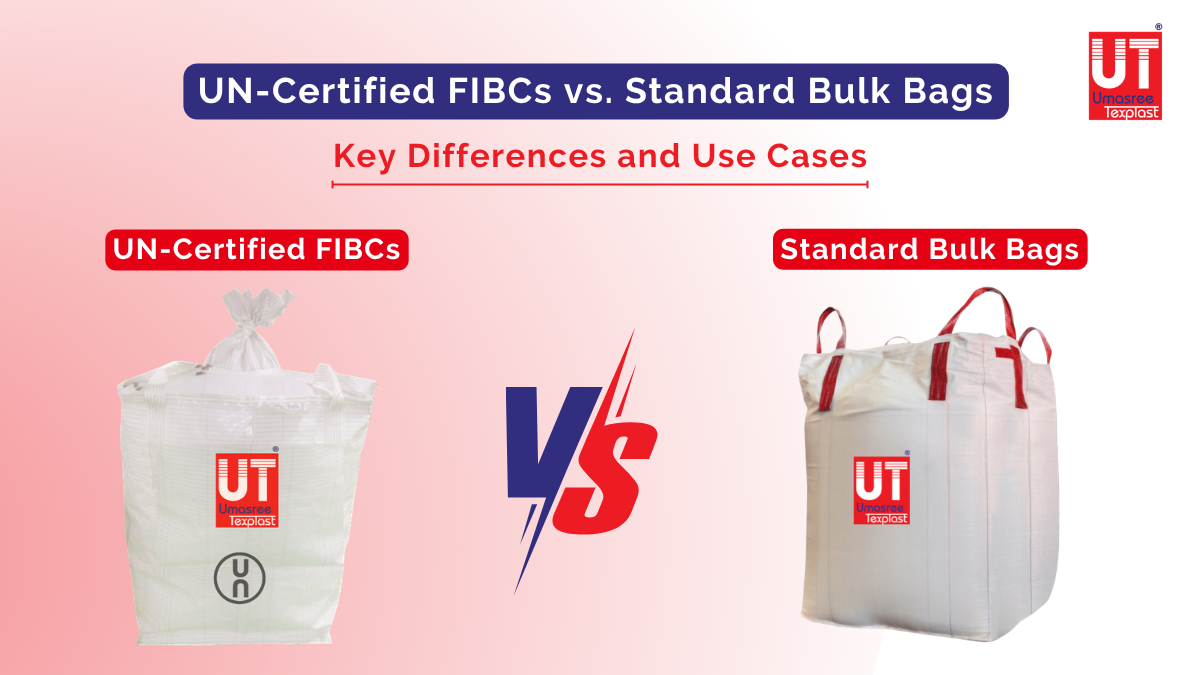
UN-Certified FIBCs vs. Standard Bulk Bags: Key Differences and Use Cases
Choosing the right bulk bag is not simply about finding a container that can hold the required weight. The material being packed, its hazard classification, transportation conditions, handling process, and regulatory requirements all influence which type of FIBC you should use.
This becomes especially important when comparing UN-Certified FIBCs vs. Standard Bulk Bags. Although both may look similar from the outside, they serve very different purposes.
Standard bulk bags provide an efficient packaging solution for many dry, flowable, non-dangerous materials. UN-Certified FIBCs, on the other hand, are specifically designed, tested, certified, and marked for transporting certain dangerous goods in accordance with applicable dangerous-goods regulations.
Understanding the difference can help businesses improve packaging safety, avoid using unnecessarily specialized packaging, and select an FIBC that matches the product and supply chain.
What are Standard Bulk Bags?
Standard bulk bags, commonly known as FIBCs, jumbo bags, or big bags, are flexible industrial containers typically manufactured from woven polypropylene fabric.
Industries use them to store and transport a wide range of dry and flowable materials, including agricultural products, minerals, construction materials, polymers, fertilizers, food ingredients, and other industrial products.
Standard FIBCs can be manufactured in different constructions, capacities, fabric types, lifting-loop configurations, filling options, and discharge designs. Depending on the application, manufacturers can also supply coated or uncoated fabrics, liners, different sewing options, and customized printing.
Their biggest advantage is flexibility. A business can configure a standard FIBC around product characteristics, filling equipment, discharge systems, storage conditions, and transportation requirements.
However, a standard bulk bag is not automatically approved for transporting dangerous goods.
That is where UN-Certified FIBCs become important.
What are UN-Certified FIBCs?
UN-Certified FIBCs are specialized flexible intermediate bulk containers designed for the transportation of dangerous goods where the applicable regulations permit the use of flexible IBCs.
Unlike ordinary bulk bags, these bags must meet specific construction, performance, testing, certification, and marking requirements.
Umasree’s UN FIBC range includes woven-plastic constructions identified as 13H1, 13H2, 13H3, and 13H4. These configurations differ based on whether the woven-plastic FIBC uses a coating and/or liner.
The current UN Model Regulations also recognize these flexible IBC construction codes within applicable packing instructions for dangerous goods.
The important point for a buyer is simple:
A standard FIBC is selected primarily according to the needs of the product and handling operation. A UN-Certified FIBC must also satisfy the regulatory requirements applicable to the dangerous goods being transported.
UN-Certified FIBCs vs. Standard Bulk Bags: Quick Comparison
| Feature | UN-Certified FIBCs | Standard Bulk Bags |
| Primary purpose | Packaging permitted dangerous goods | General bulk packaging |
| Regulatory requirements | Must comply with applicable dangerous-goods requirements | Generally selected according to normal industrial packaging requirements |
| Performance testing | Specific UN design-type testing required | Testing depends on design, application and buyer requirements |
| UN marking | Required for certified design types | Not applicable |
| Product selection | Depends on dangerous-goods classification and applicable packing instruction | Depends mainly on product, load and handling conditions |
| Construction | Controlled according to certified design | Highly customizable according to application |
| Typical materials | Certain regulated chemicals, hazardous solids and dangerous goods | Food ingredients, grains, minerals, polymers, construction materials and other non-dangerous products |
| Certification | Specific certified design type | UN certification generally not required |
| Procurement focus | Compliance + containment + performance | Performance + efficiency + cost |
The right choice therefore depends less on which bag is “better” and more on what you are packing and how it will be transported.
1. The Biggest Difference Is the Intended Material
The most important difference between UN-Certified FIBCs and standard bulk bags is what they are intended to carry.
Standard bulk bags work well for many non-dangerous bulk products. Depending on the construction and application, businesses may use them for products such as:
- Plastic granules and polymers
- Sand and construction materials
- Agricultural products
- Food grains
- Sugar
- Minerals
- Animal feed
- Fertilizer products where dangerous-goods rules do not require UN packaging
- Other dry, flowable industrial products
When the material is classified as dangerous goods, however, the packaging decision changes.
You must consider the material’s UN classification, packing group where applicable, packing instructions, mode of transport, and other relevant requirements before choosing the packaging.
A standard bulk bag should therefore never be assumed to be suitable simply because its load capacity appears sufficient.
2. UN-Certified FIBCs Undergo Specific Performance Tests
A UN-Certified FIBC design type must demonstrate that it can perform under prescribed conditions. Umasree identifies several tests applied to UN FIBCs through certified test houses, including:
- Top lift test
- Tear test
- Stacking test
- Drop test
- Topple test
- Righting test
The resulting certification relates to the particular FIBC design that was tested and the conditions and limits covered by that test.
These evaluations simulate stresses that the packaging may experience while being filled, lifted, stacked, transported, handled, or recovered.
Standard FIBCs also need appropriate quality and performance controls. However, they are not automatically subject to the same UN dangerous-goods design-type approval requirements simply because they are FIBCs.
This distinction is especially important for procurement teams. Buying a heavy-duty-looking bag does not make it a UN-Certified FIBC.
3. UN FIBC Construction Is Closely Controlled
UN-Certified FIBCs cannot be treated as generic bags where important design elements can be changed freely after certification.
Fabric specifications, webbing, liners, coatings, seams, filling and discharge construction, dimensions, and other design characteristics can influence packaging performance.
For woven-plastic UN FIBCs, Umasree highlights four common constructions:
13H1: woven plastic without coating and without liner
13H2: woven plastic with coating and without liner
13H3: woven plastic without coating and with liner
13H4: woven plastic with coating and with liner
The appropriate construction depends on the product and regulatory requirements.
Standard FIBCs generally offer greater freedom to optimize the design specifically for operational requirements such as dust control, moisture resistance, discharge speed, filling efficiency, stackability, or branding.
4. Safety Factor Terminology Is Different
Another area that can cause confusion is the safety factor.
Standard FIBCs are commonly specified using safety factors such as 5:1 or 6:1 depending on their intended use and applicable requirements. Umasree’s broader FIBC range, for example, can be produced with different safety factors according to buyer requirements.
UN-Certified FIBCs should not simply be selected by applying the same safety-factor terminology.
Umasree notes that UN bags are instead classified according to dangerous-goods packaging requirements and are not defined simply by the 6:1 safety-factor terminology commonly associated with certain FIBCs for non-dangerous goods.
For buyers, this means a statement such as “this bag is 6:1” should never be treated as proof that the bag is approved for dangerous goods.
When Should You Use UN-Certified FIBCs?
UN-Certified FIBCs should be considered when the substance is classified as dangerous goods and applicable transport regulations and packing instructions authorize or require an approved flexible IBC.
Potential applications can include certain:
Chemical Products
Chemical manufacturers may handle powders, granules, additives, or other materials classified as dangerous goods. Correctly specified UN FIBCs can provide compliant bulk packaging where flexible IBCs are authorized.
Agricultural Chemicals
Some pesticides, fertilizers, treatment products, and agricultural chemicals may fall under dangerous-goods regulations. Their classification should be checked before packaging is selected.
Minerals and Industrial Materials
Certain mineral products, compounds, pigments, processing materials, or industrial substances may have regulated classifications that require approved packaging.
Hazardous Waste
Some solid hazardous waste streams may also require regulated packaging for transportation. Selection must reflect the waste classification and relevant transportation requirements.
The important rule is to classify the product first and choose the packaging second.
When Are Standard Bulk Bags the Better Choice?
UN certification adds specialized requirements that are unnecessary for many products.
If your material is not classified as dangerous goods and no applicable regulation requires UN-certified packaging, a properly designed standard FIBC may be the more practical solution.
Standard bags can be configured for priorities such as:
- High-volume transportation
- Efficient filling and discharge
- Moisture protection
- Dust control
- Improved handling
- Food-grade applications
- Storage efficiency
- Custom dimensions
- Product identification and printing
- Specific lifting arrangements
Using the correct standard bag can deliver the required performance without introducing specifications your application does not need.
How to Choose Between a UN-Certified FIBC and a Standard Bulk Bag
Before placing an order, answer a few critical questions:
- Is the product classified as dangerous goods?
- What is its UN number and official transport classification?
- What packing group applies, if any?
- Which packing instruction applies to the material?
- Is a flexible IBC permitted for that product?
- What is the required filling weight or volume?
- Does the product require coated fabric or a liner?
- Are there dust, moisture, contamination, or electrostatic concerns?
- How will the bag be filled, lifted, stacked, transported, and discharged?
- Which transportation regulations apply in the origin, destination, and modes of transport?
Answering these questions helps avoid both under-specifying and over-specifying your packaging.
Why the Right FIBC Matters Beyond Compliance?
Bulk packaging plays a direct role in product protection and supply-chain efficiency.
An incorrectly selected bag can create problems during filling, warehouse storage, lifting, loading, transportation, or discharge. For dangerous goods, those problems can carry far greater consequences.
The goal should therefore never be to simply purchase the strongest or cheapest bulk bag.
The better approach is to select a bag engineered around the material, handling process, transportation conditions, and regulatory requirements.
Final Thoughts: Choose the Bag Based on the Product, Not Appearance
When comparing UN-Certified FIBCs vs. Standard Bulk Bags, remember that the main difference is not how the bags look. It is what they are designed, tested, certified, and permitted to do. Standard FIBCs provide versatile and cost-effective packaging for a wide range of non-dangerous bulk materials, while UN-Certified FIBCs address the additional safety and compliance requirements associated with certain dangerous goods. If your business handles regulated bulk materials, choosing packaging that matches the product classification is essential. Umasree Texplast manufactures UN-Certified FIBC Bags in multiple constructions and customization options for demanding bulk-packaging applications. Explore Umasree’s UN FIBC Bags or contact the team to discuss your material, filling requirements, transportation conditions, and suitable packaging configuration.