




What Determines the Safe Working Load of an FIBC Bag?
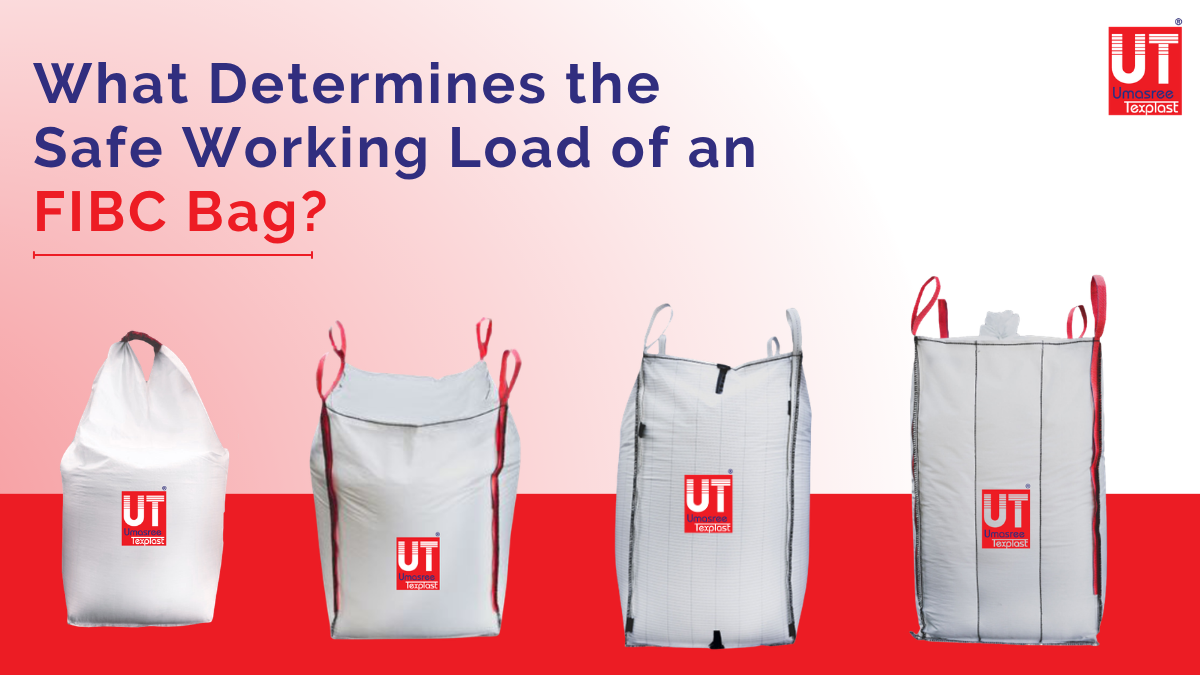
When businesses handle hundreds or even thousands of kilograms of powders, granules, chemicals, agricultural products, minerals, or construction materials, packaging strength becomes more than a convenience. It becomes an important part of safe and efficient material handling.
This is where the Safe Working Load of an FIBC Bag becomes important.
Every Flexible Intermediate Bulk Container is designed to carry a specified maximum load under defined conditions. Choosing a bag with the wrong load capacity can increase the risk of bag damage, product loss, handling problems, and unsafe lifting.
But what actually determines how much weight an FIBC can safely carry?
The answer involves more than simply making a larger or thicker bag. Fabric construction, lifting loops, seams, bag dimensions, safety factor, material characteristics, manufacturing quality, and performance testing can all influence the final load rating.
Understanding these factors can help businesses select an FIBC that better matches their product and handling requirements.
What Is the Safe Working Load of an FIBC Bag?
Safe Working Load, commonly abbreviated as SWL, refers to the maximum load that an FIBC is designed to carry during its intended use.
The Flexible Intermediate Bulk Container Association defines SWL as the amount of load, measured in kilograms or pounds, that a bag is designed to carry.
For example, an FIBC with an SWL of 1,000 kg is designed for a maximum product load of 1,000 kg when it is used according to the manufacturer’s specifications and appropriate handling practices.
The SWL should never be treated as an approximate number or a target that can regularly be exceeded. FIBCA’s handling guidelines specifically advise users never to exceed the rated SWL of an FIBC.
Umasree manufactures FIBC Bags with SWL options ranging from 250 kg to 2,000 kg, depending on the bag design and application.
1. FIBC Fabric Construction and Strength
The body fabric is one of the most important structural components of an FIBC Bag.
FIBCs are commonly manufactured using woven polypropylene fabric. The strength and construction of this fabric must be selected according to the load the finished bag is expected to handle.
Several characteristics may be considered during bag design, including:
- Fabric weight and construction
- Weaving pattern and density
- Yarn properties
- Coated or uncoated construction
- Reinforcement in critical areas
- Bag dimensions and overall design
A bag intended to carry relatively light materials may have different construction requirements from one designed for a much heavier load.
However, heavier fabric alone does not automatically mean a higher SWL. An FIBC works as a complete packaging system. Its fabric, loops, seams, dimensions, and other components must function together.
2. Strength and Design of the Lifting Loops
During lifting, the weight of the filled FIBC is transferred through its lifting system. This makes lifting loops critical to the overall performance of the bag.
Depending on the application and FIBC design, manufacturers may provide lifting arrangements such as cross corner loops, side seam loops, sleeve lifts, hood lifts, or other configurations.
Umasree, for example, offers multiple lifting arrangements as part of its FIBC construction options.
The loops must be designed and attached appropriately for the intended load and handling method.
Factors such as loop material, width, positioning, stitching, reinforcement, and compatibility with lifting equipment can therefore influence the overall bag design.
Even when the body fabric is suitable for a particular load, inappropriate or damaged lifting loops can compromise safe handling.
Operators should also ensure that forklift tines or other lifting equipment are positioned correctly and that loops are not twisted, damaged, or subjected to unsuitable handling.
3. Seam and Stitching Quality
An FIBC Bag consists of multiple components that must remain securely connected throughout filling, lifting, transportation, and discharge.
This makes seam construction another important consideration.
The stitching used to connect the fabric panels, lifting loops, top construction, bottom construction, and discharge components must be suitable for the intended application.
High stress areas may require additional reinforcement because these sections can experience considerable forces while the filled bag is being lifted.
Poor or inconsistent stitching can weaken an otherwise well designed FIBC.
For this reason, SWL is determined based on the performance of the complete bag design rather than one individual component.
4. Safety Factor
Safe Working Load and Safety Factor are related, but they are not the same thing.
The SWL tells you the maximum product load the bag is designed to carry. Safety Factor, sometimes called Service Factor, relates to the performance requirements applied to the FIBC design during testing.
FIBCA explains that common Safety Factors are expressed as ratios such as 5:1 or 6:1.
A 5:1 Safety Factor does not mean that users are allowed to load the FIBC to five times its SWL.
If a bag is marked with an SWL of 1,000 kg, its working load remains 1,000 kg.
The higher figures associated with the Safety Factor relate to testing and design requirements rather than normal operating capacity.
Umasree offers standard FIBC Bags with SWL options between 500 kg and 2,000 kg and Safety Factor options of 5:1 and 6:1. Its broader FIBC range also includes designs for single trip and multi trip applications.
5. Single Trip or Multiple Trip Application
How an FIBC will be used can also influence its required construction.
Some bags are designed for a single trip application, while certain FIBCs may be designed for multiple trips under controlled conditions.
It is important not to assume that every FIBC can simply be emptied and reused.
FIBCA advises that reusable FIBCs should operate within a controlled closed loop system where the bag is cleaned, reconditioned, inspected, tracked, and appropriately tested for its intended reuse.
The intended number of uses should therefore be discussed with the FIBC manufacturer before selecting the bag.
6. Size, Shape and Bag Dimensions
The physical dimensions of an FIBC also matter.
Two bags may have similar nominal capacity but behave differently depending on their height, width, base construction, filling method, and internal design.
Once filled, the material inside the bag places forces on the bottom, side walls, seams, and lifting structure.
This means the manufacturer must consider not only how much material the bag will contain but also how that material will sit inside it.
Bag geometry can also affect stability.
A correctly selected FIBC should therefore consider both weight and volume rather than SWL alone.
This becomes particularly important when handling products with very different bulk densities.
7. Bulk Density of the Material
One of the most overlooked factors when choosing an FIBC Bag is product bulk density.
Consider two materials filling approximately the same volume.
One may be a relatively light agricultural material, while another could be a dense mineral or chemical product. Even though both occupy similar space, their total weight may be considerably different.
That means choosing an FIBC based only on physical size can result in the wrong bag specification.
Before ordering FIBCs, buyers should provide the manufacturer with information such as:
- Material being packed
- Bulk density
- Required filling weight
- Desired bag dimensions
- Filling method
- Discharge method
- Transportation method
- Storage conditions
With this information, the FIBC can be designed more closely around the actual application.
8. Filling, Handling and Transportation Conditions
A bag does not operate in isolation.
How it is filled, lifted, moved, stacked, stored, transported, and discharged affects the conditions it experiences throughout its service life.
For example, lifting the bag unevenly, allowing sudden shocks, dragging it across rough surfaces, or using unsuitable equipment can place stresses on the FIBC that were not part of its intended operating conditions.
FIBCA’s safe handling guidance includes precautions such as checking the FIBC for damage before use, ensuring lifting devices are suitable, maintaining appropriate lifting practices, and never exceeding the stated SWL.
Selecting the correct SWL is therefore only the first step. Following proper handling procedures is equally important.
9. Testing and Manufacturing Standards
SWL should be supported by appropriate design, manufacturing controls, and testing rather than being selected arbitrarily.
Performance testing helps verify how the complete FIBC behaves under specified test conditions.
Umasree states that its FIBC Bags are manufactured in accordance with ISO 21898 and that certificates are held following testing at reputed laboratories.
Testing becomes especially important because an FIBC contains several structural elements working together. A weakness in the fabric, loops, stitching, or another component can affect overall performance.
For specialized applications, additional standards and testing requirements may also apply.
For example, FIBCs intended for dangerous goods follow specific UN requirements. Umasree notes that UN certified bags undergo tests that can include top lift, tear, stacking, drop, topple, and righting tests. These bags are classified according to applicable dangerous goods requirements rather than simply using the conventional Safety Factor classification applied to ordinary non dangerous goods FIBCs.
How Do You Choose the Right SWL for an FIBC Bag?
The best approach is to start with the actual application rather than choosing a bag solely from a capacity chart.
Ask these questions before placing an order:
What will the bag contain?
Identify the material and whether it has any special handling requirements.
What is its bulk density?
This helps determine how much the filled bag will weigh at the required volume.
What quantity will each bag carry?
The intended filled weight should remain within the certified SWL.
How will the bag be lifted?
Forklift, crane, filling station, and other handling systems may require different lifting arrangements.
Will it be used for a single trip or multiple trips?
This must be established during the design and specification process.
Does the material require a specialized FIBC?
Food products, hazardous goods, combustible powders, moisture sensitive materials, and other applications may require additional bag features beyond basic SWL.
Providing this information to your FIBC supplier makes it easier to develop an appropriate bag specification.
Why the Correct FIBC SWL Matters
Choosing the correct Safe Working Load is ultimately about matching packaging to the real conditions in which it will be used.
An appropriate FIBC specification can support safer lifting, efficient storage, reliable transportation, reduced risk of product loss, and smoother material handling operations.
More importantly, users should never increase filling weight simply because an FIBC appears capable of carrying more material. The SWL printed on the bag should always be respected.
From fabric construction and lifting loops to seams, bag dimensions, bulk density, Safety Factor, handling conditions, and performance testing, many elements contribute to determining the load capacity of an FIBC Bag.
When choosing bulk packaging, work with a manufacturer that can design the bag around your material, filling weight, handling process, and industry requirements. Umasree offers a wide range of FIBC Bags with multiple SWL, lifting, filling, discharge, fabric, and liner options for diverse industrial applications. Explore our FIBC Bag solutions and connect with Umasree to find a bulk packaging solution suited to your specific handling requirements.